

ECE
About Department
The Department of Electronics and Communication Engineering (ECE) at CMR College of Engineering & Technology was established in 2002 with the vision to produce globally competitive engineering graduates with social awareness and become centre of excellence through research in the areas of Electronics & Communication Engineering by delivering quality education, advanced technical training and research excellence in Electronics and Communication Engineering and allied fields. The department introduced the M.Tech programme in Embedded Systems in 2009. Since 2022, the department has been recognized as a Research Centre by Jawaharlal Nehru Technological University Hyderabad (JNTUH).
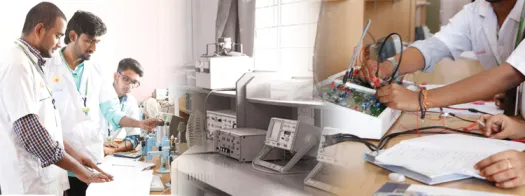
The B.Tech(ECE) programme has been accredited by the National Board of Accreditation (NBA) four times in 2008, 2014, 2017, 2021 and 2024 with the latest accreditation valid until June 2027, reflecting sustained academic quality and outcome-based education practices. The institution received NAAC ‘A’ Grade in 2014 and ‘A+’ Grade in 2020 and has been a UGC Autonomous institution since 2014.
The department has received DST-FIST funding of ₹30 lakhs and secured nearly ₹1 crore in R&D grants, strengthening its research infrastructure. It offers comprehensive academic instruction in electronic circuits, communication systems, VLSI design, embedded systems, signal processing and emerging wireless technologies, supported by well-equipped laboratories featuring tools such as Cadence, Xilinx, CST, MATLAB, Multisim and LabVIEW.
To promote innovation and industry readiness, the department has established Centers of Excellence in Drone Technology, Cadence VLSI Design, Antenna Design and RF Systems using CST and LabVIEW-based Virtual Instrumentation. These centers provide training in UAV systems, ASIC design and verification, antenna modeling and electromagnetic simulation, as well as real-time data acquisition and automation systems, aligning student competencies with modern industry requirements.
With experienced and research-oriented faculty, the department emphasizes project-based learning, research publications, internships, and participation in national-level competitions. Continuous collaboration with industry and research organizations ensures that graduates are professionally competent and prepared to meet the evolving demands of the electronics and communication engineering field.
- BEC: The Basic Electronic Circuits Laboratory introduces first-year ECE students to fundamental components and circuits through hands-on verification of diode characteristics (PN junction, Zener), rectifier circuits (half-wave, full-wave with/without filters), transistor input/output characteristics (BJT/FET common-emitter/source configurations) and basic clippers, clampers, voltage regulators using regulators like 78xx series.[8][6] Students use breadboards, multimeters, CROs, function generators and DC power supplies to measure V-I curves, ripple factor, efficiency, voltage gain and load regulation, building foundational skills in circuit assembly, measurement techniques and troubleshooting before advancing to complex analog/digital labs.
- AC: The Analog Circuits Laboratory focuses on designing, simulating and verifying analog amplifiers, oscillators and pulse circuits using tools like Multisim, with experiments on common emitter/source amplifiers (frequency response, gain-bandwidth), two-stage RC-coupled amplifiers, feedback amplifiers, cascode amplifiers, RC phase shift/Wein bridge/Hartley/Colpitts oscillators, class A/B power amplifiers, linear wave shaping (RC LPF/HPF), nonlinear wave shaping (clippers/clampers), transistor switching, multivibrators (astable/monostable/bistable) and UJT relaxation oscillators.
- ADC: The Analog and Digital Electronics Laboratory introduces students to practical implementation of basic analog and digital circuits using standard electronic components and trainer kits.[1][2] Students learn to design, build and test rectifiers, amplifiers, oscillators, logic gates, combinational and sequential circuits, gaining confidence in circuit analysis, hardware realization and use of lab equipment such as power supplies, function generators and CRO/DSOs.
- ECA/STLD: The Electronic Circuit Analysis Laboratory gives students hands‑on experience with key analog circuits such as single and multistage amplifiers, feedback amplifiers, power amplifiers and oscillators. It helps students analyse gain, bandwidth, frequency response, distortion and stability, using measuring instruments and where applicable, basic simulation tools. The Switching Theory and Logic Design Laboratory concentrates on digital circuits, allowing students to implement and test combinational blocks (adders, subtractors, multiplexers, encoders, decoders) and sequential circuits (flip‑flops, counters, shift registers). Through experiments on logic trainer kits and ICs, students learn how Boolean algebra and logic diagrams translate into real hardware, improving design, debugging and verification skills in digital systems.
- BASIC SIMULATION: The Basic Simulation using MATLAB Laboratory introduces ECE students to MATLAB fundamentals for signal processing, circuit simulation and system analysis through programming and visualization. Students perform matrix operations, generate basic signals (sinusoidal, exponential, step, ramp, sin), plot continuous/discrete signals and apply simple transformations like convolution and frequency domain analysis using FFT.
- PYTHON: The Python Laboratory introduces ECE students to Python programming fundamentals with a focus on applications in signal processing, data analysis, automation and hardware interfacing relevant to electronics and communications. Students engage in hands-on experiments covering basic syntax (conditionals, loops, functions), data structures (lists, dictionaries, tuples), file operations, exception handling and introductory NumPy for numerical computations on ECE datasets like signal samples. The lab uses Python 3.x environments with Jupyter notebooks or IDEs, building skills for simulation, visualization and scripting in advanced ECE courses.
- LDICA: The **Linear and Digital IC Applications Laboratory** provides hands-on training in designing, assembling and testing practical circuits using linear integrated circuits like the 741 op-amp for applications such as inverting/non-inverting amplifiers, summers, integrators, differentiators and active filters (LPF/HPF), along with 555 timer ICs for monostable/astable multivibrator waveform generation, while the digital portion covers verification of basic logic gates, realization of flip-flops (SR/JK/D/T), counters, shift registers, adders and multiplexers using standard TTL/CMOS ICs, enabling students to analyse performance parameters, troubleshoot issues and correlate theoretical concepts with real hardware behaviour through standard lab equipment like function generators, CROs and multimeters.
- MC: In the Microcontrollers Laboratory, DOSBox runs classic 8086/8051 assembly programs (using MASM/TASM) by emulating the DOS environment on modern PCs, allowing students to edit, assemble, link and debug microprocessor code for tasks like data transfer, arithmetic operations and block sorting. Keil µVision IDE serves as the primary tool for 8051 microcontroller development, where students create projects, write embedded C or assembly code, compile to hex files, simulate execution with peripherals (timers, interrupts, I/O ports) and generate downloadable firmware for trainer kits or Proteus simulation.
- IOT: The IoT Laboratory using Arduino IDE software uses Arduino IDE to program Arduino boards (like UNO) for interfacing sensors and actuators in IoT prototypes, with experiments including LED blinking, button-controlled LEDs, LDR-based automatic night lamps, LM35 temperature sensing, DHT11 for temperature/humidity, ultrasonic HC-SR04 for distance, PIR motion detection, traffic light simulators, water flow sensors and relay modules for home automation. Students write C/C++ sketches in the IDE, verify/compile, upload via USB and monitor serial output for debugging, covering GPIO control, analog reads, libraries (e.g., DHT.h, LiquidCrystal) and real-time applications like smart monitoring systems.
- MWOC: The Microwave and Optical Communications Laboratory equips students with hands-on experience in high-frequency microwave experiments using Klystron/Gunn diode benches to study reflex klystron characteristics, VSWR/wavelength measurements, directional couplers, E/H-plane tees, magic tees, horn antenna patterns and dielectric constants, alongside optical Fiber communication kits for LED/laser diode I-V characteristics, numerical aperture determination, Fiber attenuation/bending losses and analog/digital link performance analysis including frequency response, eye diagrams and BER measurements.
- VLSI: The VLSI Laboratory equips students with industry-standard EDA tools like Xilinx Vivado/Quartus for FPGA prototyping and Tanner/Mentor Graphics/MICROWIND for CMOS design, where they implement and verify digital circuits using Verilog/VHDL for logic gates, adders, multiplexers, counters, FSMs, ALU and UART with full RTL simulation, synthesis, place & route and bitstream download to FPGAs, alongside analog/digital CMOS layouts (inverter, NAND/NOR, half adder, differential amp) featuring schematic capture, DRC/LVS verification, parasitic extraction and post-layout timing/power analysis in 180nm/130nm processes.
Vision:
To produce globally competitive engineering graduates with social awareness and become centre of excellence through research in the areas of Electronics & Communication Engineering.
Mission:
- To impart quality education to the students through quality faculty in the domain of Electronics & Communication Engineering and related fields to make them globally competitive in employment and higher education.
- To pursue research in Electronics & Communication Engineering and related disciplines in order to serve the needs of the society.
- Develop self-learning abilities and professional ethics to remain professionally competent so as to serve the society.